
Reading time:
8 min
Investing despite all-time highs
When stock markets hit new record highs, it usually makes the headlines. Often, «experts» in interviews warn about an impending market crash. Maybe in situations like these, you get a nervous, uneasy feeling in your stomach. Should you hold off on investing and wait for the market to drop? Or should you rather play it safe and sell your investments? It all sounds pretty logical, but statistically speaking, it’s usually a mistake. What do you do if you’ve sold and the markets keep climbing? When will you invest again so your money can get back to work for you? If you're plagued by thoughts like these: don't worry, you are definitely not alone! The question «Should I still get in now?» is one of the most common ones we hear. We prefer to rely on facts rather than an uncertain gut feeling. So let's first take a look at the history books of the US stock market—the one with the most publicly accessible data.
THE MOST IMPORTANT POINTS AT A GLANCE:
All-time highs occur more frequently than you think. In themselves, they are not a warning sign of an impending stock market crash. On the contrary, those who try to time the market miss out on a lot of returns.
Temporary declines in value are completely normal on the stock market. They are «tests of courage» but they are the price you have to pay for long-term investment success.
Invest for the long term, regularly, and cost-effectively. Use the dollar-cost averaging method and sit back.
Index
Advice from a financial blogger
Nick Maggiulli, a well-known blogger and book author from the US, analyzed the daily closing prices of the Dow Jones Industrial Average Index - which tracks the price performance of thirty of the most well-known US stocks - over a period of 110 years (1915 to 2025).
He calculated the probability of ending up in the loss zone in the future if you bought the index on any given day.
Result:
Invested at an all-time high: 97% probability of experiencing lower prices at a later point
Invested on any other day: 96.7% probability of experiencing lower prices at a later point
Conclusion
It makes almost no difference! No matter when you buy, sooner or later you will experience temporary price drops (Unsurprisingly, Maggiulli's award-winning book is called Just Keep Buying). That’s just the normal rhythm of the stock market.
This study might seem a bit simple to you now. That’s why here comes a second one by Ben Carlson, who works together with Maggiulli. He compared record-high days with non-record-high days.
To do this, he calculated the future performance for 1, 3, and 5 years over a period of 75 years (1950 to 2025), assuming you bought the S&P 500—a famous index containing the 500 most valuable US companies—on any given day. The following graphic summarizes the results:
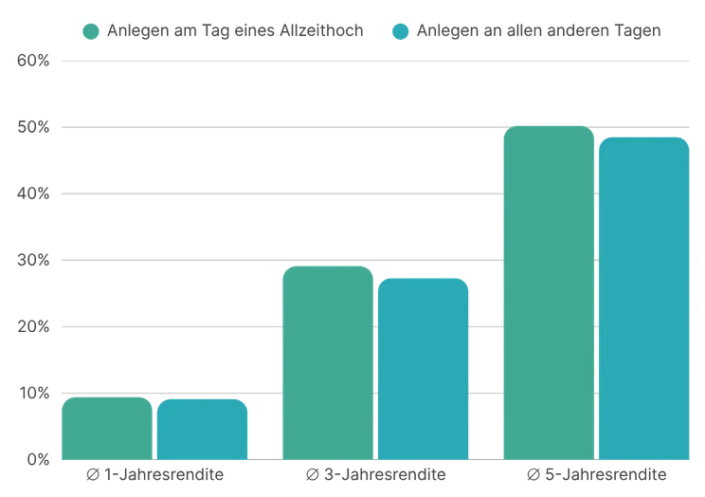
The analysis is quickly done: There are virtually no differences! If you look closely, you’ll see that on average, it’s even slightly better to invest on days with an all-time high.
Conclusion
Ignore all-time highs and invest your savings regularly, no matter what happens! But how do things look over longer investment horizons?
Practical advice – Back and forth empties your pockets
A traditional wealth manager from the UK (Schroders) confirmed Carlson's calculations above—however, under slightly modified circumstances. The firm examined the monthly closing prices of US stocks on an inflation-adjusted basis over a 98-year period (1926 to 2024).
Two additional observations from the same study are particularly interesting:
During those nearly 100 years, US stocks were at an all-time high 31% of the time.
A strategy that sold stocks every time an all-time high was reached, parked the funds in a bank account, and only returned to the stock market when there was no longer an all-time high, performed worse over every selected long-term period than a classic buy-and-hold strategy.
Such a market-timing strategy resulted in significantly lower returns! The following table assumes an initial investment amount of 100 US dollars:
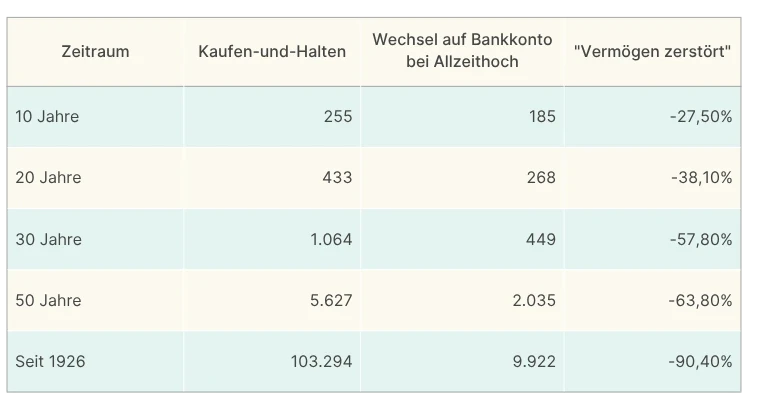
The absolute figures in particular reveal the huge extent of performance you can miss out on over the long run!
As an example: If you had invested an average of 100 US dollars in the S&P 500 index on any random day and watched your money grow over 30 years, it would have grown to an average of 1’064 US dollars. Meanwhile, the strategy of repeatedly selling stocks whenever an all-time high was reached achieved 449 US dollars—less than half of that!
Conclusion
Always stay invested and never trust your gut feeling blindly when the stock market is at an all-time high! History shows that giving in to your emotions every time would have been super harmful to your wealth.
So much for the scientific evidence. Now comes the tough part – your emotions…
Our advice – Stay disciplined!
While the observations above show long-term average values, your everyday life and thoughts happen in the short term.
The thing is, one of these all-time highs will indeed be «the» point right before a major drop. Every now and then, a bear market occurs (stock market slang for a price decline of a broad index of more than 20%).
The problem: Nobody knows in advance which high will be the last one before the bear market!
We would all love to know exactly when that moment happens. Countless professional investors and retail investors alike try again and again to catch that exact timing. Science, however, has a clear verdict on this: Only a tiny minority succeeds continuously*. Many let themselves be guided by their own emotions, making mistakes «in the heat of the moment» and missing out on future performance.
We are convinced that your gut feeling is a bad advisor. The most important ingredient for long-term investment success is your discipline!
*Interested readers can find fascinating material in the studies by Sharpe (1991) – The Arithmetic of Active Management, Fama & French (2010) – Luck versus Skill in the Cross-Section of Mutual Fund Returns, Barber & Odean (2000) – Trading is Hazardous to your Wealth, and Bessembinder (2018) – Do Stocks Outperform Treasury Bills?
Here are three tips to help you stay disciplined:
1) Trust the facts: Financial history tells you that stocks generate attractive returns over the long term, that broad indices rise in most years on average, and that investing at an all-time high also leads to attractive results in the long run. The chances are great, no matter what doom-prophets conjure up daily! This is proven by records of both US stocks (see above) and Swiss stocks. According to Pictet, a Swiss private bank, Swiss stocks generated an average gross return of around 7.7% per year over the last 100 years.

2) Keep calm: Losses cause far more pain than the joy you feel from gains*. In short, a period of sustained value declines feels bad. Your instincts urge you to «flee»—meaning to sell your investments so the pain stops. But when you panic-sell, a temporary paper loss turns into a permanent loss of money! Since 1988, we have daily data from the Swiss stock exchange: The total performance of the SPI (Swiss Performance Index), which includes all stocks traded on the Swiss stock exchange, is presented below. Green bars show annual returns and red bars show the maximum decline within the calendar year.
*Interested readers can check out either the original study by Kahneman & Tversky (1979) – Prospect Theory or, for something more entertaining, Kahneman's monumental 2011 work Thinking, Fast and Slow.
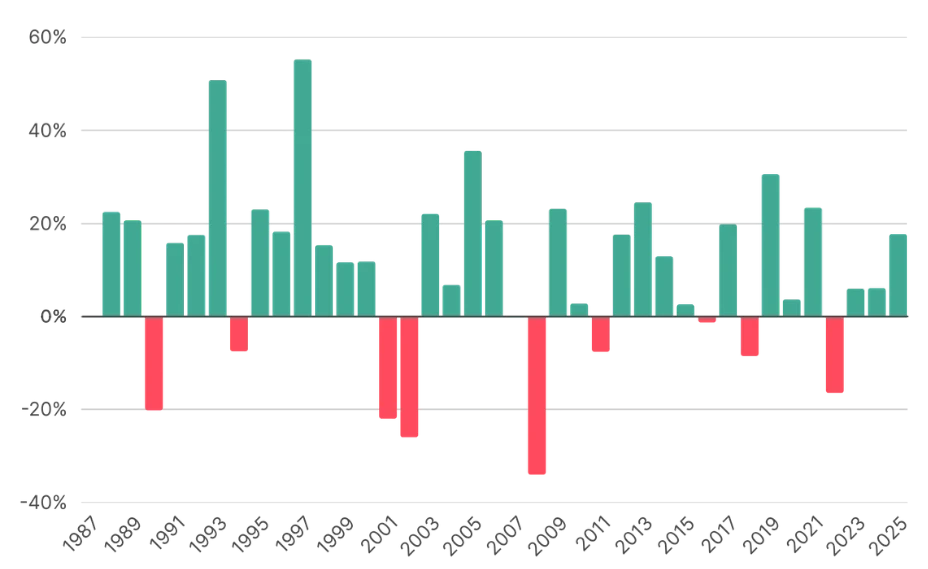
The analysis from this 38-year period reveals exciting insights:
Only eight years ended with a negative return, meaning prices rose in more than three out of four years!
The best year (1997) delivered a performance of 55.2%, while the worst year (2008) saw a loss of 34.2%.
The average performance per calendar year was 10.4%…
… but the average maximum price drop within a single year was just as deep at -15.2%.
This last observation is particularly interesting! Investors have to digest significant price drops every single year. A great example is 1998, which ended with a delightful return of 15.4%. The road there was bumpy, though, as the temporary maximum price decline reached 37%!
Conclusion: If you want to achieve long-term performance, you have to be able to endure short-term fluctuations. These «tests of courage» can test your nerves, but they are the price you pay for long-term investment success!
3) Be systematic: Keep your emotions out of it when it comes to investing your hard-earned money. Automate as much as you can! A concrete tool we love is the dollar-cost averaging method. With this approach, you regularly invest the exact same amount of money (e.g., monthly). That way, you catch both low and high entry points. When you do this over the long run, you achieve an average purchase price and feel little to no regret! You steadily build up wealth and profit from the long-term upward trend of the stock market.
The following graphic shows the path of the SPI total performance. All red data points mark days that ended at an all-time high:

This analysis is no less fascinating:
Swiss stocks closed at an all-time high on almost 7% of days.
The maximum price drop from a previous all-time high was nearly 55% (2008 financial crisis).
The longest period from one all-time high to the next was 2’174 days or almost six years (starting, of course, with the outbreak of the 2007 financial crisis).
Six years in the loss zone is a long time and requires great discipline to stick with it. But here too, history shows that staying calm and holding on was completely worth it!
Conclusion
All-time highs shouldn't make you nervous! They happen much more often than you think. Once you've invested your savings, definitely stick to your strategy, no matter what comes your way. That means continuing to buy even at new highs. Time will reward you!
Your best move is to follow our recipe: Invest for the long term, regularly, and at low cost.
We wish you great investment success!
P.S.: You don't have to invest all your assets in stocks either. Depending on your capacity and willingness to take risks, a balanced investment solution consisting of stocks, bonds, real estate funds, and precious metals might be perfect for you, for example. Everyone is different, and a good wealth manager knows that! We’d love to guide you along the way.