

Reading time:
4 min
How are my investments with findependent taxed?
To make sure no questions arise during your tax return, we explain here the most important points regarding the taxation of your findependent investments. It is actually much easier than it might seem at first glance.
THE MOST IMPORTANT POINTS AT A GLANCE:
On one hand, the process of filling out your tax return is straightforward thanks to the free e-tax statement. On the other hand, the tax implications are manageable, especially since the majority of the returns are tax-free capital gains. In comparison to the long-term average annual return, the tax burden remains low.
Index
How do I declare my findependent account and investments on my tax return?
We automatically generate a free e-tax statement for you. You’ll find it in the document section of the app starting from the second half of February (don’t worry, we’ll also remind you via our newsletter). You can easily download this e-tax statement as a PDF and drag-and-drop it into your electronic tax return. All the relevant values for wealth and income taxes will be transferred in just a few seconds.
How much tax will I pay on my findependent investments?
Here’s the short answer: If you’ve invested CHF 20’000 in the findependent investment solution Balanced, it will cost you around CHF 80 more in taxes annually. And in return, it brings you an average annual return of around CHF 1’000 in the long run.
The details: The tax office distinguishes between wealth tax and income tax. Wealth tax is relatively low, while income tax can be higher depending on your overall income. But here’s the good news: the majority of the returns from your findependent investment solution are tax-free capital gains.
Wealth Tax
The total value of your findependent investment solution is subject to wealth tax, just like all other movable assets (e.g., jewelry, cars, bank balances) and immovable assets (e.g., real estate). Exempt from wealth tax are pension fund assets, vested benefits accounts, and pillar 3a accounts.
In most cantons, there is a tax-free allowance or similar exemption for wealth tax. Wealth tax only applies once this threshold is exceeded.
Here’s an overview for some cantons (as of May 2024). Wealth tax applies starting at the following asset levels:
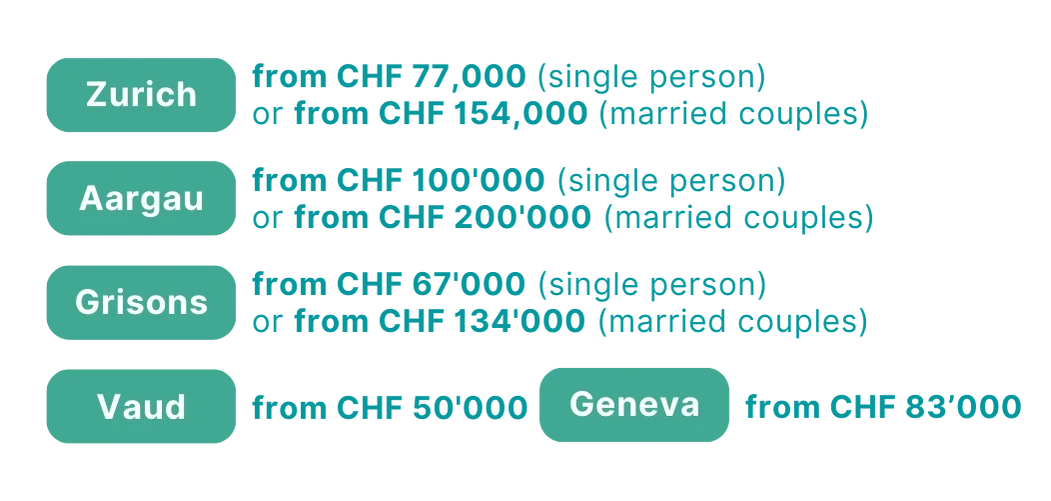
This overview, of course, doesn’t indicate the actual tax amount. For that, you’d need to consult the canton’s tax rate or use their tax calculator.
According to the latest federal survey (2015), the median wealth for individuals aged 41 to 45 is CHF 72,000. Based on this, at least half of the Swiss population does not pay wealth tax.
Let’s take the example of a single, childless person with no religious affiliation, living in the main town of their canton, with CHF 200,000 in assets. Roughly speaking, the following annual wealth taxes apply:
Canton | in CHF (ca.) | in % (ca.) |
Zurich | 150 | 0.07 % |
Aargau | 100 | 0.05 % |
Grisons | 250 | 0.12 % |
Geneva | 400 | 0.20 % |
Waadt | 600 | 0.30 % |
Let’s assume the following:
You live in Aarau, are single, childless, and have no religious affiliation. Your total wealth is CHF 150’000. After deducting the exemption (Canton of Aargau: CHF 100’000), your taxable wealth is CHF 50’000. Of that, CHF 20’000 is invested in the findependent investment solution Balanced.
The CHF 20’000 in your findependent investment solution results in an annual tax burden of around CHF 20.
Important: This wealth tax applies to you either way. You’ll pay it, whether the money is sitting in a savings account or working for you in an investment solution.
Taxes on the returns of the findependent investment solution
The return on your findependent investment solution consists of income and capital gains.
Here’s an example: With a total return of 5%, about 3.5% comes from capital gains, which are tax-free. The remaining 1.5% is taxable income.
Let’s assume the following: You’ve invested CHF 20’000 in the findependent investment solution Balanced. You live in Aarau, are single, childless, and have other taxable income of CHF 80’000. The 1.5% income on your invested CHF 20’000 results in a tax burden of CHF 76.60. The total return in our example is CHF 1,000 (5% of CHF 20,000). As you can see, the tax burden is relatively small.
So, you don’t need to worry about taxes when investing. Don’t let it hold you back – make more of your savings! We wish you lots of fun with your investments!